This is a record of regular city council meetings in Prince Albert, Saskatchewan. Meetings are now held 20 times a year, usually on the 2nd and 4th Monday of the month. Comments on other civic government meetings, as well as on issues that are of interest to city residents, are also included.
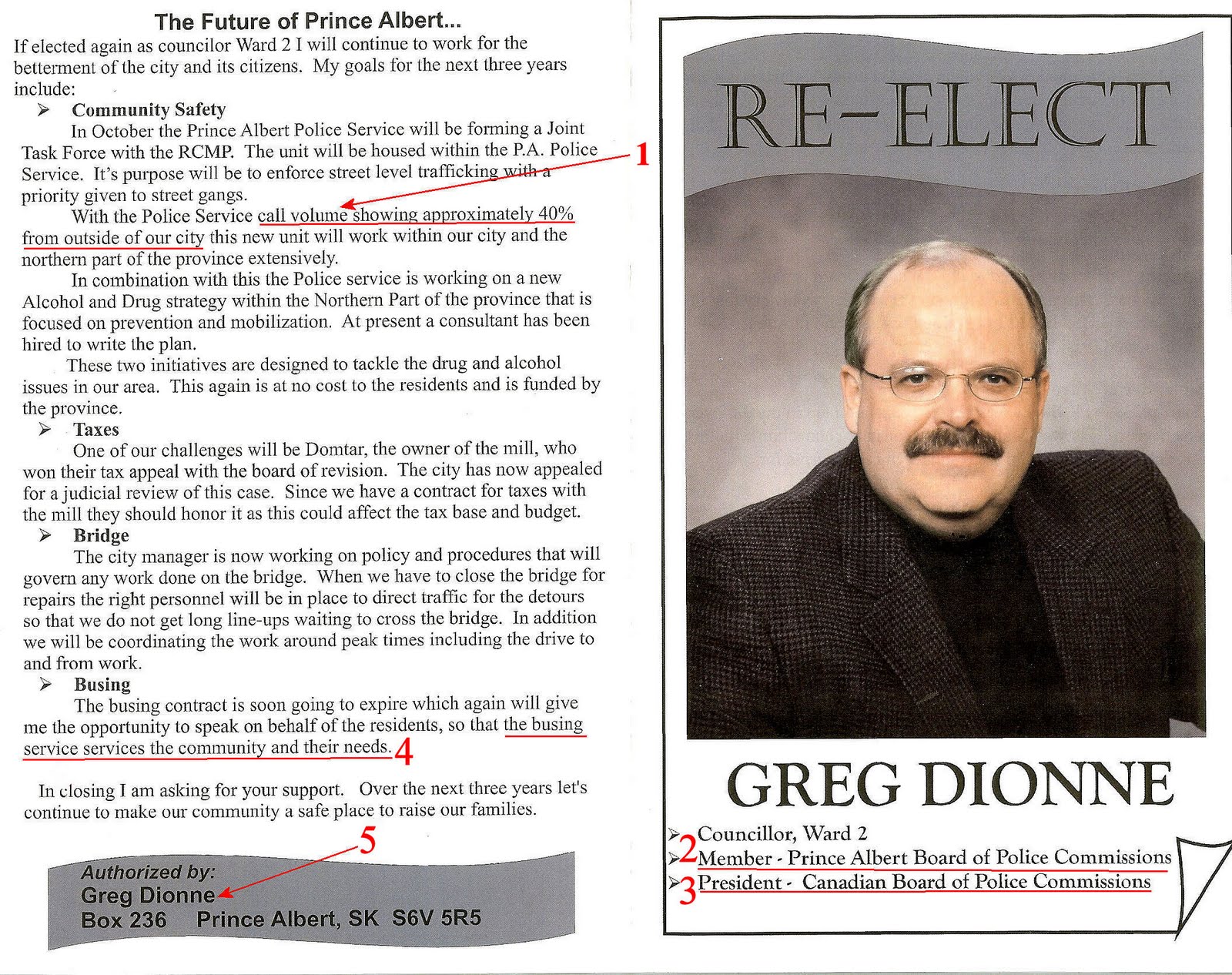
To be precise, only “type four” voters (the rare breed who study the contenders thoroughly before voting) can be counted on to actually read election flyers - and there aren’t many of those. [“Type one” votesagainstone candidate by marking an ‘X’forsomeone else; “type two” voters (my nemesis) support the candidate who will provide them with a personal benefit (for example, a job, tax reduction, recreation facility, microwave, toaster, peaches, or a meal); and “type three” supports an individual they identify with - because they belong to the same political party, club, or church, or with whom they share an occupation, hobby, alma mater, viewpoint, or something else deemed important.] For these dedicated individuals, I provide the following analysis of Greg Dionne’s 2009 civic election pamphlet, followed by an analysis of Brian Clavier’s main Ward 2 campaign flyer. Click each image to enlarge it. -------------------
General Impression
This is an expensive flyer. Never mind the glossy (coated) paper stock, it’s in colour. The viewer first sees a picture [not a very recent one, since it was also used on the fridge magnet/note pads he gave away three years ago] that makes the guy look REALLY big. That’s helpful if people need a city councillor to wrestle for them - or, in this case, act as a personal on-call security guard [Nordale residents lap that up]. The photo imagery is thus directed at the type two constituency - seniors, specifically, who want personal security - and is reinforced by the double reference below the photo to his close association with the police function of the state, as well as the lengthy, prime-position “Community Safety” section on the back of the flyer.
Although the back of the flyer repeats the wavy banner we see above the photo on the front, its impact is diminished by the monotonous grey colouring. What’s worse, the overall graphic design easily surpasses the criteria required for entry into the ‘Extremely Boring’ category of election literature.
Fortunately, the front of the pamphlet has minimal text. This visual plus is overwhelmed, however, by the wordy, ungrammatical, over-wrought text crammed onto the back. Reproducing excessive verbiage for public consumption is meant to create a positive impression on type four voters, but even they can’t be asked to read this much. Remember, the majority of voters don’t read election pamphlets, so giving them an essay-length text is pointless.
Individually-Numbered Items
1. This is a perfect example of writing so inept that it totally misconstrues the thought it tries to express. If “Police Service call volume showing approximately 40% from outside our city” was truly a fact, then the PA Police Service should have handed those calls to the RCMP, since the PA Police Service has no jurisdiction “outside our city.” What the writer means[and I know this from having attended multiple PA Police Service presentations in the past five years, and reading the local daily newspaper] is that 40% of the calls that the PA Police Service members attend to involve police interacting with people who are not residents of Prince Albert. Of course, we can’t bill their home towns for having to deal with them, so the statement is meaningless - other than as justification for continuing the tradition of giving annual police budget increases that are larger than those given to any other city department [9% in 2009, when everyone else was restricted to 2%].
2. It would be helpful if this member of the Prince Albert Board of Police Commissioners knew the correct name of the body he sits on [as one of three city council members appointed to the five-person Board, itself just one of 63 committees, boards, and commissions that council members were appointed to in 2008]. Citizens should personally thank the councillor for advocating and approving increases to the police budget that total over 25% since 2006 - for a department whose budget shamelessly shows spending of less than $200 on fuel and oil for its fleet of gas-guzzling Chrysler and Ford vehicles in both 2007 and 2008 [a miracle of biblical proportions].
3. As President of the Canadian Association of Police Boards [odd, that the President of the CAPB doesn’t know the name of the organization he’s supposed to lead - see http://www.capb.ca], the councillor is supposed to ensure the Association works “diligently to achieve the highest standards as the national voice of civilian oversight of municipal police.” Apparently, being a cheerleader for federal legislation to create a new class of crime against seniors constitutes “oversight.”
4. Sibilants saturate this sloppy sentence. Is it really that difficult to write “so that the transit system services the needs of the community”? By the way, he didn’t “speak on behalf of the residents” when the new busing contract was approved at the November 23, 2009 council meeting.
5. Even at the municipal level of government, election advertizing is supposed to be authorized by a candidate’s official agent - not the candidate. If no one wants to do that simple job for the candidate, it usually means he’s a one-man show. The post office box referred to here is the only contact information in the pamphlet: no street address, e-mail, web site, or phone number is provided. The subliminal message to the reader? I don’t want you to contact me.
6. It’s fairly obvious that his lack of language skills is compensated for by his desire to please, provide, and protect. As for his time, it is amazing how he can manage a mall in Prince Albert, one in Saskatoon, and a third in Regina and still attend to all his council duties.
7. In Prince Albert, “perfect attendance” by council members is an abused concept: from 1980 until the November 23, 2009 council meeting, every council member was permitted to miss meetings during three weeks each year, and still have their attendance record publicly reported as “100%.” Naturally, this policy generates more fiction than fact. While the average number of regular, special, and committee meetings of council is two per week, there are fewer of them in June, July, and August. So if a council member was away for three weeks in March, he could miss seven or eight meetings, while a colleague who was away for three weeks in August might only miss two or three meetings. Nevertheless, if they didn’t miss any other meetings, both would have “100%” recorded [and publicly flogged] as their official attendance record. This ridiculously self-serving policy was finally terminated by a motion passed at the November 23, 2009 council meeting.
As for the councillor’s “perfect attendance,” his meretricious claim neglects to account for or explain the three-week-absence policy, or specify the time period for which he claims to have had perfect attendance - all omissions that devalue his claim. In fact, he was absent from the January 12 and May 25 regular council meetings in 2009, and missed the special meetings of council held on January 19, 2009; December 17, 2008; and August 23, 2007 [the City Clerk still keeps meeting minutes].
8. Again, there is no such thing as the “Canadian Board of Police Commissions.” Being elected President of the Canadian Association of Police Boards brings no benefits to residents of the City of Prince Albert; it does award the officeholder with additional meetings to attend and chair [and the opportunity to engage in self-aggrandizement].
9. A big “Please don’t say that!” for this all-too-common error: the correct expression is “In regard to . . .” [Think about it: the speaker doesn’t need multiple looks at the one item being presented.] This “Quick Look at the Voting Process” is truly condescending . . . read in its entirety, the section reveals self-reflection at its most banal.
10. Apologize? Okay. But tell people what you will do differently if elected!
11. Pray tell, on which motions did the penitent pontificator cast an “imperfect” vote? Was he, in fact, “unsuccessful” in voting “correctly”? Unless people attend council meetings, they don’t know how a councillor voted on every issue, since the Shaw cameras don’t show how everyone votes; recorded votes are rare [and have to be researched on the city’s web site]; and this councillor sometimes abstains from voting [famously, on the Northern Spruce housing project on 22nd St. and 5th Ave. West, in August 2009].
12. I guess everyone just knows that he manages the Gateway Mall, and they phone him there; otherwise it’s impossible to make this claim. [It’s hard to find his home phone number, since it’s not in the paper phone book or online directory. Youcanget his number by calling 411 - and pay 75¢ for the privilege, as noted on the phone bill below - or searching the City of PA web site.]
Given how fast and loose the pamphlet is with the truth, I’d feel better if we could see a summary of the complaints he’s received, one that includes the issues that were resolved. [A spreadsheet, such as the one I designed this year for use by MLAs, could easily convey such detail.]
The Loser’s Campaign Flyer (generally speaking) This is what you’d expect when the candidate has limited campaign funds: while it’s printed on heavier paper (24-pound, 96 brightness), which alleviates the see-through problem that often arises from printing on both sides of a sheet, the inkjet printer used to print these gives a product whose ink runs when wet, and it just doesn’t have the cachet of three-colour offset printing.
You can tell that the itinerant councillor has worked on election campaigns, since the text is brief; the front photo shows intensity, and is mildly flattering (in front of a recognizable landmark in the ward, taken on August 23, 2009 ); it borrows, alters, and repeats a slogan from a successful campaign [Barack Obama made more headway with “Change you can believe in,” but he had the financial backing needed to get his message drilled into the electorate]; and the visual presentation is simple yet full of (straightforward) graphics [evidence of the De Stijl art movement’s influence on the candidate]. The use of four typefaces, in at least five different sizes, works because of the carefully segmented text and the large areas of empty white space [just like any good résumé].
Type four voters would be pleased to see that this guy is educated, can write a meaningful, grammatically-correct sentence, and doesn’t blather on about anything. Directed specifically at type four voters, he has to repeat the reference to more information being available on his blog. Actually, there’s also ample messaging directed at type one and type three voters, with a lack of consideration for the needs of type two voters clearly the pamphlet’s weakest element.
The inside of the pamphlet is less coherent than the exterior. On the interior, the visual presentation dominates the content. For example, the check-mark boxes are tacky, and awkward (because there are so many). At least the reader can readily see that the candidate cares enough to regularly attend council meetings, and puts in extensive, unpaid time and effort speaking at them about a variety of topics. [Most people elected to council have never spoken at a council meeting, and all those elected in the past ten years attended only a handful of such meetings (at best) before being elected].
Individually-Numbered Items 1. It sounds trite, but the most-asked question on a municipal campaign doorstep is “When’s the election?” This flyer reminds you of the date front, back, and inside - thoughtful, and smart. Using three different typefaces for the date was a good idea.
2. The candidate’s name should appear as many times as reasonably possible in a flyer [the worst excess in respect to this guideline is having the candidate’s full name at the beginning of every bullet point or sentence], and it should stand out from the text around it. Putting the name directly under the photo is ideal; it’s bad form, however, to scream at the reader. (In other words, using all upper-case lettering adjacent to a photo is a no-no, but elsewhere it’s okay).
3. The slogan is a simple twist on Obama’s 2008 campaign theme. It loses impact if the “you” is not visually differentiated from the rest of the phrase.
4. The candidate mentions his environmental bent on the front, the back, and the inside of the flyer, so including the plea to recycle in all three locations should be expected. Unfortunately, only election flyers that I have designed plead with voters to do the responsible thing with paper campaign material. It should be standard wherever paper recycling exists.
5. References to educational background are purely for the benefit of type three and type four voters - a distinct minority of the electorate. Types one and two don’t care if a candidate’s most noteworthy scholastic achievement was dropping out of Okeefenokee Junior High in the first week of September. This litany of learning laurels is useless on a campaign flyer (though it does lend credibility to the ambition expressed in the sentence that follows it).
6. Here we finally have a goal statement, the achievement of which is plausible given the introductory phrase. The problem is, Prince Albert voters don’t care about “sustainability.” [It could easily be argued that they care about, and are motivated by conspicuous consumption, distancing themselves from “the unwashed masses,” and guaranteed redemption at Armageddon.] The mention of financial health is good, but should have gone on to directly refer to property taxes and the city’s long-term debt.
7. This is a comprehensive listing of contact information for the candidate. [No one can say this guy’s hiding in a post office box.] It gives everyone, regardless of technological capacity, an opportunity to contact him with the technology they are most comfortable using. Locating this summary on the back of the pamphlet is the best place for it.
8. These numbers show the candidate is indeed dedicated to monitoring city council’s activities. It means more when you realize that he spoke at the podium at the meetings he attended, based on his prior reading of documents available to the public. Unfortunately, this type of intellectual philanthropy is irrelevant to all but type four voters. [Had he promised a Wal-Mart or Co-op gift card for every residence in the ward - or beer and pizza, as requested by a couple of electors - that would have generated some positive buzz.]
9. Again, the candidate indicates he does something that is of limited interest to type one and type two voters. Types three and four appreciate this work, but it does require some effort from them to verify the candidate’s claim. [If voters could be convinced that there is entertainment or educational value to be derived from reading the blog, that would be a plus. Perhaps he should have added, “Read it- and be prepared to be entertained, enraged, enlightened, and/or enthralled.”]
10. In municipal ward campaigns, it’s supposed to be important to actually live in the ward. Mr. Clavier’s emphasis on both living and working in Ward 2 means he works out of his home, so probably knows what’s happening in [and important to people living in] this geographic area. This should resonate with the electorate, except that only a select few know where the ward boundaries are, and this ward is both the largest and most diverse one in the city. Ultimately, voters want their councillor to know what’s happening on their street, in their back yard, so every candidate has to proclaim his intimate familiarity with the ward [even if he works in two other cities, and spends countless hours each week travelling between his home, multiple workplaces, and cottage].
11. Aside from providing the details for contacting the candidate, this downsized phrase gently blurts out a request for assistance (of any kind). Impoverished campaigns have to ask (as often as possible), and this four-word footnote is a tactful way of doing so. [The other guy’s financially-flush campaign doesn’t need this type of invitation on his pamphlet, which invites only an “X” on a piece of paper.]
12. In municipal councillor contests, the candidate is the campaign - not volunteers, or the broadcast or print media ads, stories, or articles. At the same time, I think it’s preposterous for a candidate to present himself on his election signs or literature as the official agent for the campaign. My official agent was the same this year as in 2006 [though the presence of his absence was particularly noticeable this year].
Paving Petition Explanations, SPCA Solicits $upport, and Green Whatever
ABSENTEES: Councillors Darcy Gervais and Shawn Williams
BACKGROUND DOCUMENTS: 312 pages
PUBLIC GALLERY: Janice Semchuk, Debbie Lehner, Gary Anderson, Jim Kereluk, Brian Clavier, Rick Sawa, Joleen McCullagh, Vera Culy, Steve Lawrence (after 8:26), and four others. START: 7:02 PM
Tell Me Again: Why Can't You Pave 13th Avenue?
- Jim Kereluk, who appeared at the September 8 meeting to request consideration of a petition to pave 13th Ave. West, between 14th St. and 15th St., did not yet understand why paving 13th Avenue required a successful petition from the landowners in the 1200 and 1300 blocks of 14th St. West. He repeated the comments in his September 15 letter.
-Public Works Director Colin Innesrepeated that none of the four properties adjacent to the avenue fronts on the avenue. He said it could be oiled. Mr. Kereluk replied that oiling was out of the question.
- Mayor Scarrow asked if the residents would pay for the avenue to be paved. Mr. Kereluk replied that they pay for 14th St. to be oiled. The Mayor said a face-to-face meeting with city officials is needed, adding that oiling streets is antiquated, and extending the payback period for pavement could be a possibility.
-Councillor Atkinson remarked that, to get the avenue paved, 14th St. would have to be paved, and it was his understanding that the people living there were not receptive to paving that street.
-Councillor Zurakowskisaid people leave with "their head spinning" on this type of issue. He asked: what is the cost of paving, what is "modified paving," and do we need curbs?
-Director Innesexplained that "modified paving" happens when a top layer of asphalt is applied to a road surface that has had several years of oiling. Curbs help prevent asphalt from cracking on the edges, as well as direct water to the sewers.
-Councillor Dionneadded that "modified paving" does not have the life span of regular pavement. He made a motion to set up a meeting with the department.
-Mr. Kereluk reminded council that "everybody on 14th Street" feels the same - they can't afford pavement.
- Mayor Scarrowpointed out that paying for oiling dovetails with the current program, where credit is given for previous oiling when a street is paved.
- The SPCA desperately needs a replacement for its building at 680-10th St. East (Exhibition Drive). The purchase of a suitable lot in the North Industrial area has been negotiated, and a building campaign to raise $3.5 - $4 million is underway. Under-supported for years [if not decades . . . .], the city's budget allocates an additional $33,000 to the SPCA shelter this year.
- Councillor Atkinson, noting that the 2010 SPCA budget projects $15,000 in licensing fees, asked if this was "modest," or is there additional potential money available from that source.
-SPCA Board Chair Joleen McCullaghreplied there could be, if the city's bylaw enforcement officers cooperate. Atkinson commented that the operation of the shelter is efficient, as it expects to have a budget surplus. McCullagh replied that generating revenue to sustain the facility has been a focus - without asking the city for additional funding.
-Councillor Swystunsaid the revenue projections were ambitious. He is concerned about the new building's total cost, given that city finances are "challenged." The city's ability to participate in funding the new facility "requires discussions."
- Councillor Ring noted the $33,000 increase in city funding in 2009 - an increase from $47,200 to $80,000. He wondered if the city was being asked for a contribution to the capital project, for a $3.5 million facility. Joleen replied that the fund-raising campaign would be very aggressive.
- Councillor Swystunsaid council needed to know the results of the campaign before it could determine the city's contribution.
-City Manager Cotterillintoned that council could not meet with the SPCA in private [although a majority of council had no such qualms with respect to the $16 million soccer centre . . . .], council could not commit itself until after the [October 28, 2009] election, and the SPCA could still meet with city administration.
- SPCA Campaign Chair Gary Andersonsaid the building plans had been received earlier in the day, and he did not think the cost would come in at $3.5 million. He added that the city's contribution did not have to be capital, saying "we will have to get creative."
- Councillor Atkinson said that the city had "gotten off lightly in the past," given the need: when he visited the SPCA shelter the previous week, he was suprised to see that the staff microwave was in the euthanasia room. [Atkinson's September 27 blog post contains a link to a US site with a contest that could help the Prince Albert SPCA building campaign: go tohttp://www.theanimalrescuesite.com/, click to automatically donate food, then scroll down and click to vote for your favourite animal shelter. Type "Prince Albert SPCA" in the "Shelter Name" box, select "Canada" and "SK" from the drop-down box lists, click on "Search," then click on "Vote" and you will have voted for the Prince Albert SPCA to receive a share of $100,000. The winning shelter gets $20,000. There are also two $1,000 prizes for the Canadian shelters that get the most votes. As of October 5, we were at 88th place among Canadian shelters. You can vote once a day until December 20, 2009.]
- Councillor Dionne, while recognizing the SPCA's need, said the 2010 budget "will have lots of challenges" [not unlike the $40,000 spent in 2009 for two cameras on the Diefenbaker bridge, or the $25,000 suggested for a miniature helicopter that flies for 15 minutes on its batteries, we presume . . . .] He said the SPCA should come back to the council elected in October.
7:47 PM
-Gary Andersonsaid he appreciated the difficulty of the timing for the city. While there is currently no contract in place between the city and the SPCA, he reminded council that the city has collected pledges for various fundraising campaigns in the past, and the SPCA will be doing this for this campaign. Of the financial institutions in the city, he asserted only Conexus Credit Union might give the SPCA a mortgage.
- Mayor Scarrow said that previous meetings with the SPCA have not specified the dollar contribution requested of the city.
7:51 PM Gary Anderson, Joleen McCullagh, and Debbie Lehner leave.
Rezoning from R5 to C4 at 166-27th St. W. and 2640-2nd Ave. W. (to make room for Venice House pizza relocation)
- Janice Semchuk, speaking for her mother, Vera Culy, repeated the issues with this rezoning that are found in Teena Logodin's letter - noise until the early hours, increased traffic on 27th St., and the potential for future rezoning.
- Mayor Scarrow[forgetting that this information was in the background documents, on pages 126, 257, and 258 . . . ] asked about a report on the permitted uses in a C4 zone, and what the intentions of the developer were.
- Councillor Zurakowski said the neighbours want to know the business' hours of operation, and whether a buffer strip has been proposed. He asked if council can require a buffer strip.
- Councillor Dionne said, intentions aside, the developer has to come back for a development permit [at which point there isdiscretionwith respect to whether a public hearing is held . . . .] He needs to know the developer's intentions [he didn't read page 126 either] because he does not want to "burden the next council " with one of his decisions [apparently, none of his decisions over the past six years as a councillor will be a burden to future council members . . . .] 7:58 PM
- Councillor Atkinson said hedid not see a lack of commerical space or property in the city, and does not see promotion of business acctivity as more important than the "cohesiveness of a neighbourhood."
- Mayor Scarrow believed there was a general feeling that the developer had not provided requested information [he did not specifywhatinformation had been requested, or who had requested it].
- Councillor Zurakowski moved to postpone the issue [again: it had been postponed from the September 8 meeting], saying he had spoken to the neighbours, and got some phone calls. Some were in favour of the project, since there had been problems with rentals here in the past.
[NOTE: While there is nodifferencebetween a "postponement" motion and a "tabling" motion, other than the spelling, councillors still needed to immediately air their weighty thoughts on this topic: Matheson (twice), Ring, Dionne, and Swystun continued to speak about it - instead of voting on Zurakowski's motion, thereby disregarding the procedural rule that prevents discussion of a tabling motion . . . .]
- Councillor Mathesonwas concerned that they may be reading too much into this. He wouldlike to see the change go ahead, since there are "safety valves" for some of the concerns expressed.
- Councillor Ringstated that three residential lots were being taken for business use, and 2nd Ave. is a business street. He thought that, eventually, "we would hit Bryant[now Kinsmen] Park." Asking the developer for more information, he said, then turning the proposal down, would not be "good for the developer" [a comment that illuminates the rationale for the no-discussion-of-a-tabling-motion rule in its starkest form. . . .]
- Councillor Dionnesaid, "I feel handicapped," explaining that council was being asked to rezone the land, the developer would come back for a development permit, and council can ask what his plan is. He feels the developer should "make the neighbours feel comfortable," and that there is "too wide a spectrum" of discretionary uses for him to support rezoning.
8:06 PM
- Councillor Swystun said this was a transition zone, and people feel like "they're being invaded." The developer should "go that extra step, tell us his plan," and do public relations withthe residents.
- Councillor Matheson opined, "We have to be seen as proactive, and as respecting the residents' wishes." Since this area hasn't "seen much lately," he was concerned that "we're moving backwards."
- THE VOTE (to postpone the issue): 5 - 2 in favour, Councillors Atkinson and Matheson opposed.
8:11 PM Four more people leave - five people left in the public gallery. 8:26 Steve Lawrence joins the public gallery.
The Mayor and Council Attended/Were Feted By . . . .
8:34 PM
- Councillor Atkinson asked if the mayor had his usual long list of events attended, remarking, "I find them so interesting." Scarrow replied, "If I can find it . . . ." - Councillor Swystun was at Mont St. Joseph's (5th) Grandparents' Stroll-a-thon, the biggest one yet. - Councillor Atkinson informed council about Riverbend Institution's September 28 information session about CORCAN goods and services at the PA Exhibition Centre; asked [again] about the EA Rawlinson Centre financial statements; and noted the fact that tickets to the venue's events can now be purchased online. - Councillor Ring asked if Atkinson was making an inquiry. Atkinson replied that Mayor & Councillors' Forum used to be where they could make comments, rather than review social calendars. He then asked about the report on the second bridge, urging administration to present it to council and the public. City Manager Cotterill said that the EA Rawlinson information would be given to the new council, as would a formal presentation from the province on the second bridge (a request for the report was sent in June). Scarrow said the RMs of PA and Buckland had also signed the June letter to the province, and shortcomings in the report needed to be addressed to satisfy all three jurisdictions. - Mayor Scarrow's attendance list included: the opening of the North Central Enterprise Region office, a PA Parkland Health Region meeting in Shellbrook (where the residents appreciate all the services PA provides, except for road closures on 28th St. and 25th St.; Colin Innes interjected that the roads around the hospital would all be open by mid-day on September 22 [eliciting a half-clap from Zurakowski]), the Living Sky Growers seed orchard in Henribourg, the Terry Fox Run, Metis Fall Festival flag-raising and opening, and the SPCA Walk for Paws. - Councillor Swystun said the 28th St. and 10th Ave. work was a major project, one that accommodates future residential development for 2500 to 3000 people, the total cost of which is $12 million, while the public sees only ten blocks of pavement. He offered congratulations to Colin Innes and his staff.
Inquiries: Dionne Missed Attendance Reports, and Unfinished Asphalt
- Councillor Dionne requested reports on councillors' attendance in 2008 [unknown to him, this was presented to council at its January 5, 2009 Executive Committee and January 12, 2009 regular meetings - see pages 41 to 44 of http://www.citypa.ca/Portals/0/PDF2/Council_Meetings/2009/2009%2001%2012%20-%20City%20Council%20Meeting/Agenda.pdf] and for the January to September 2009 period; an update on the grant program for community clubs through the Municipal Economic Enhancement Program; and a plan for directing traffic during bridge closures (since he had to delay a meeting for 45 minutes the previous week). Cotterill replied that the Mayor, Colin Innes, and he had met about the September 16 bridge tieup earlier in the day, and a policy would be prepared. - Councillor Atkinson asked about the 28th St. asphalt, which "looks unfinished." Cotterill said the policy is to put down "one lift" of asphalt and check the status of the base the following year, then finish laying the asphalt. The mayor asked if weight restrictions were needed in the interim, and Cotterill replied, "No." - Mayor Scarrow asked about the report on the intersection at 15th St. and 4th Ave. West. Cotterill said it was on the work plan for next year. The mayor then said that "shading" text areas would be eliminated from reports in the future, which would "save toner, save the environment."
Public Forum - Green Resolution and Green Whatever
8:59 PM
- Rick Sawa[allowed to speak for over 6 minutes (with a 5-minute limit)] talked about nuclear energy, energy options for Saskatchewan, the Uranium Development Partnership report, and the report on public consultations prepared by Dan Perrins. He asked council to send a resolution to the provincial government to conduct an energy needs study for the province. [Council will discuss this at its October 5 regular meeting.]
- Brian Clavier talked about the "green industrial park" the city is planning on developing. His comments are reproduced below. My topic tonight is the Green Industrial Park - or Hub - or should I say Green Energy Park - or something else. I’m not sure which title is correct, since it’s been called by at least four names: when it first surfaced six months ago, in a March 16 news release (with no indication such a project was being considered outside the cover of the Bruce Power nuclear proposal), it was called an “industrial hub centred on Green Energy.” This was clarified in a May 1 news release, where it became the “Green Energy Industrial Hub.” But last week’s news releases referred to it as both the “Green Industrial Park” AND the “Green Energy Park,” as did the Mayor on TV earlier this evening.
The name might not seem important here, but out in the real world a “green energy park” means that the energy-related research and business activity conducted there cannot have negative effects on the environment. So any business associated with nuclear power is necessarily excluded from such a “park.” Equally important, a “green energy park” excludes the more general class of “green industry” claimants - so environmentally-innovative C & A Floor Coverings, a US firm with multiple “green” awards, would not legitimately qualify for inclusion in PA’s “Green Energy Park.”
In contrast to this, a “Green Industrial Park” - or “Hub” - should offer a home to any business that has a zero carbon foot print; or is involved in the production of “clean” energy; or facilitates the reduction of energy and water consumption, recycling, or waste minimization. SARCAN, for example, could be a legitimate resident of a “Green Industrial Park,” as could Habitat for Humanity’s Re-Store, and a company that recycles tires into door mats. But businesses associated with nuclear power generation would again not qualify.
As you might expect, the “Green Industrial Park” label is more common than “Green Energy Park.” To see what such an industrial park might look like, you need only go to Hinton, Alberta, or the former St. John shipbuilding yard in New Brunswick. Industrial parks like these encompass a wide variety of businesses, whose main claim to being “green” is that they use much less water and energy, and generate less waste, than traditional industrial enterprises; the degree of “green-ness” they possess is normally evident in which level of LEED certification the individual firms have achieved [remember, LEED stands for Leadership in Energy and Environmental Design].
On the other hand, a “Green Energy Park” should be restricted to a narrower commercial segment. Aside from companies that make wood heating pellets and ethanol from wood waste, two possibilities which were mentioned at last week’s press conference, it might welcome - companies that make bio-diesel from algae - or dandelions, or quack grass; - windmill vendors; - energy conservation consultants; - hydrogen fuel cell developers; - propane and electric car conversion companies; - geothermal heating contractors; - solar wall distributors; - solar hot water heating suppliers; - solar electric system designers and installers; and - companies that develop energy conservation software.
Whatever type of commercial “green” park is being contemplated for Prince Albert, we should all applaud the $3 million application for federal Community Development Trust funding that’s been submitted.
I note that Troy Metz, the city’s former consultant on this project, has been replaced. Mr. Metz, the President of Canadian Bio Energy Management Inc., was charged in Florida with securities fraud by the Securities & Exchange Commission three months ago. The new consultant, the CEO of Canadian Bio Energy Management Inc., Robin Woodward, did commendable work for the mayor’s election campaign in 2006. I am certain he will be as competent working on a commercial “green” park for this city.
Have a safe walk home.
And the Last Word:
- The Mayor thanked administration, Shaw Cable, and the public contributors.
PUBLIC GALLERY: Brian Clavier, Darwin Zurakowski, Jim Kereluk, and four others.
START: 7:02 PM
Public Hearing: To Permit an 88-foot Telecommunications Tower at 597-28 St. West[council denied the permit at its July 20, 2009 meeting, and voted at its August 18, 2009 meeting to give the proponent another try]
-Brian Clavierwas opposed to the tower's construction. His comments were:
I'm speaking in opposition to this 88-foot tower - again, like I did on July 20th. I believe in the rule of law. When the rule of law is ignored, the rules of favouritism and caprice apply.
According to the rule of law, this development permit should not be granted, because the proponent’s license of approval from Industry Canada (more about that in a minute) and Aeronautical Clearance Certificate are nowhere to be seen - at least not by my eyes, or anyone else in the public. If you read the relevant material (on pages 57 to 71, 371, and 372) you will see that this proposal hasnotchanged since July 20th. Whathaschanged is that council decided, on August 18th, to give Mr. Zurakowski one more kick at the cat. The September 2nd letter from him makes the business case for the tower; but does not address the legal requirements that must be met for you to approve the development permit.
I’m now going to repeat the arguments against approving this tower.
The Industry Canadarequirementsfor approving telecommunications towers up to 140 feet tall are detailed in the city planner’s reference to them on page 166 of the background documents for the March 9 council meeting[in the original version of this document (not the one you can see online as of September 15, 2009, where page 166 contains tower specifications), which is reproduced at left . . . .]where they are lumped into one phrase, a phrase that’s repeated in the middle of page 57 in the documents for today’s meeting. Item 1 on that page says, the applicant shall “provide the city with a license of approval from Industry Canada.” So if you approve this development permit, youarelegally obliged to insist that Mr. Zurakowski adhere to the following Industry Canada requirements:
1. there mustevidenceof public consultation [need I say that written evidence carries more weight than a simple verbal assertion to this effect? And in this case, notification of'registeredproperty owners' ignores the tenants of Molstad Place] 2. the applicant must comply with Health Canada’s Safety Code 6 guideline for the protection of the general public [that means they have to find that guideline, read it, and provide written evidence that they are in compliance with it - no evidence of having done this has been provided] 3. the applicant must comply with radio frequency immunity criteria [no evidence of having done this has been provided] the applicant must 4. notify nearby broadcasting stations [the Rawlco stations, plus CTV, CBC, Missinipi, and the new Christian Radio station as well: no evidence of having done this has been provided] 5. the applicant must give evidence of having taken environmental considerations into account [that means more than flower beds - it means that they sought out other alternatives, and are mitigating the possibility of collisions with birds: no evidence of having done this has been provided], and 6. the applicant must obtain an Aeronautical Clearance Certificate from Transport Canada [and this Clearance Certificate has not been provided].
None of the six Industry Canada criteria has been met in the documents given to the city so far.
If you understand the rule of law, you will ensure that every application - and there's another one coming up on September 21[sic - October 5: from one Don Zurakowski, whose quest for a tower at 267-27th St. West started in May 2005 . . . .] - for a telecommunications tower higher than 50 feet meetsallof the Industry Canada requirements. Your insistence on applying the “discretion” to overlook the Industry Canada legal requirements is inexplicable - as is taking a second look at the same proposal you had before you in July.
- Darwin Zurakowski said that he has the documents from the federal government, having received them "on Tuesday." [If this means thepreviousTuesday, September 1, he should have submitted them to the City Clerk for inclusion in the meeting documents forthisTuesday, September 8 meeting.]He also has five signed documents[again, none were provided to the City Clerk or council]from people that support him, including the residents at 698 Buchanan Drive [which is outside the 75-meter-radius area where residents are notified about such development permit requests; and none from Molstad Place or the church across the street] and 588 Laurier Drive. [The 75-meter notification zone is interesting - mainly because it's such ashortdistance. For example, stand at the bottom of the wheelchair ramp on the west side of City Hall, walk west (taking care not to bump into John Diefenbaker's accusing finger), and 75 meters gets you acrossmostof Central Avenue - but still a few steps shy of meter #26 on the west side of Central . . . .]
- Economic Development Director Corneilinterjected "We don't ask developers" to obtain the federal government documents or the $2 million liability insurance until the project has been approved [by council, apparently]; they have to meet these conditions before construction is approved [by the Department of Economic Development & Planning . . . apparently. Note that Advantage Credit Union supplied an Aeronautical Clearance Certificate and an insurance certificatebeforetheir tower on 16th Street West came up for approval at City Council - see pdf file pages 180 and 182 of the meeting documents for March 9, 2009, at http://www.citypa.ca/Portals/0/PDF2/Council_Meetings/2009/2009%2003%2009%20-%20City%20Council%20Meeting/Agenda.pdf Obviously, there is flexibility in what the Department requires of tower applicants - and what Council sees - that is liberal for Mr. Zurakowski and restrained for Advantage Credit Union.]
- THE VOTE (to approve the permit for the 88-foot tower): 5 - 2 in favour, Councillors Williams and Dionne opposed, Mayor Scarrow and Councillor Atkinson abstaining.
7:11 PM Darwin Zurakowski leaves.
Public Hearing: To Sell Lanes Adjacent to the Former Prince Charles School Property to the Owner (Amigo Developments) and Two Property Owners on the East and West Side of the North-South Lane
- Brian Clavier spoke in opposition to the sale of these lanes, noting that there was no detailed site plan for the school property, so the lanes may be needed as lanes. He reminded council that a golden opporunity to create a green showcase was missed when the property was sold to a developer to create single-family homes.
- THE VOTE (to refer to the bylaws portion of the meeting): in favour [with no discussion].
7:17 PM
Public Hearing: To Re-zone 2640-2nd Ave. West, 166 and 188-27th St. West from R5 to C4, to Allow Venice House to Re-locate from 3300-2nd Ave. West
-Councillor Dionne, stressing that "we're here to listen," wanted to give the area residents "one last chance" to comment on this.
- Councillor Zurakowski moved a tabling motion.
- Councillor Atkinson said there should be buffer zone criteria, such as for opening hours, when a business like this is moved to a residential area.
- THE VOTE(to postpone the matter): 6 - 2 in favour, Matheson and Williams opposed, Scarrow abstaining.
Request & Petition to Pave 13th Ave. West, from 14th to 15th Street
- Jim Kereluk, owner of 1301-14th St. West, explained that the avenue is dusty, cars spin their wheels here frequently, and clothes can't be left on the clothesline due to the dust.
- Public Works Director Colin Innes said street paving is paid for by the frontage owners, and the "flank" is covered by the city for corner lots [meaning that the 1200-block and 1300-block owners would have to successfully petition for pavement on 14th St. before the city would pave 13th Ave., as there are no properties fronting on this avenue].
- Councillor Dionne asked if the city oils an avenue [13th] when the street[14th] is oiled. Innes said he would have to look into this.
- THE VOTE(to receive and file): in favour.
7:38 PM
Implementing a Passenger Facility Fee at the Airport
- Councillor Atkinsonwondered whether the cost of improving the airport should be borne solely by passengers - couldn't freight users also bear some of this cost?
- Councillor Ringsaid we are one of the last airports to implment this, and businesses in the airport know it is needed.
- THE VOTE (to request an additional report on the amount of the fee, implement the fee starting January 1, 2010, and sign the relevant agreements): in favour.
Banter over Banner for Value Village
- Value Village requested permission for an over-sized banner on their storefront, for two consecutive two-week periods, advertizing their Hallowe'en costumes.
- Mayor Scarrow asked why they had this request.
- Councillor Gervais said it was because of the size of the banner.
- Councillor Dionne intoned, "It's called 'order'."
- Director Corneil said the sign bylaw requires such requests when the banner is going to be up longer than two weeks.
- Mayor Scarrow replied that banners are up all the time at Councillor Dionne's enterprise[the Gateway Mall]. Dionne responded that this was because his engineering department could not get two poles to hold a sign up at the mall.
7:57 PM
- Councillor Matheson called "Question."
- Councillor Dionneshot back, with a smile, "On this important matter?"
-THE VOTE(to allow the banner): in favour.
8:00 PM
The Mayor & Councillors Attended/Were Feted by . . .
- Councillor Ring said the 100th anniversary celebrations at the golf course had wrapped up, golfers were impressed by the local hospitality, the health district and Raiders' golf tournaments were successful, and this was a fitting sendoff to course pro Danny Jutras.[Since the city pays agolfprofessional, perhaps it should also pay for a full-time hockey coach, soccer coach, figure skating instructor, swimming coach, baseball manager, waterslide expert, and skateboard pro for the other municipal facilities where "sport" is enjoyed.] - Councillor Gervais mentioned the receipt of the Northern Lights Community Development Corporation donation, and the rapid replacement of the Parkland Community Club outdoor rink - which "looks great." - Mayor Scarrow attended sod-turnings for PA Community Housing Society and River Bank Development Corporation projects; related the details of a visit from the Mayor of Lahr, Germany; was at the official opening of the West Hill infrastructure project (28th St., from 4th Ave. to 10th Ave. West); spent Labour Day in Kinsmen Park, with 500 people, from 4 to 7 PM; and participated in Literacy Day. - Councilor Swystun reminded all that Mont St. Joseph's grandparents' day was coming up on September 13.
8:08 PM
Inquiries: Greedy Cities, An Illegal Sign, Excessive Whistling, and Accounting for Money Pits
- Councillor Dionne, recognizing that Martensville and Meadow Lake were about to become cities, wondered if the pool of provincial funds the exisiting 13 cities draw from would be reduced next year. City Manager Cotterill replied that the pool would not change, since it is based on the 2006 census, when the two communities were towns. Dionne then asked about the huge sign [promoting Adanac Point, a new, consumption-oriented, gated enclave on the east edge of the city]on the trailer beside the police station: is this a case where the sign owner waits for bylaw enforcement, and can we fine the trailer owner? Finally, he noted that Carlton Trail Railway has a new engineer, one who likes to "lay on the horn" as he crosses 15th St., 2nd Ave., and the bridge. This "happy whistler" is causing great annoyance. Can the city contact the railway about this?
- Councillor Atkinson asked about the replacement of lead water connections in the 200 block of 11th St. East: if the city had gotten homeowners involved, and communicated better with them, these residents might have been able to arrange for replacement of the leaded water lines inside their homes at the same time. He also asked for the 2008 financial statements from the EA Rawlinson Centre and the operating costs/revenue projections for the soccer centre.
- Councillor Zurakowski corrected Atkinson, saying there was no "public viewing" of the soccer fieldhouse. He then relayed a complaint from truckers about the quick change of the traffic lights at 15th Ave. and 15th St. East, and asked for an update on the Rotary Trail in the 28th St. West area.
Power of a Tower, and We Only Want THIS Green Space
ABSENTEES: Councillors Martin Ring and Shawn Williams
BACKGROUND DOCUMENTS: 356 pages
PUBLIC GALLERY: Brian Howell, Brian Clavier, Ron Burns, Rick Potratz, Kelly Skiffington, Ron Burns, James Harris, Janita Kohlruss, Jim Bahr, Marina Lyons, Michel Lanoie, Eric Lanoie, Darwin Zurakowski, Shane Lazarowich, and about twenty-five others (18 in the foyer).
START: 4:03 PM
Public Hearing: Bylaw to Allow an Increase in Garage Sizes - from a Maximum of 10% of Lot Area to 12% (550 square feet to 600)
-Brian Clavier spoke against the proposed change. He disagreed with "the heart and soul of this bylaw," describing his 240-square-foot garage, on a 4,680 square-foot property, as large enough: if he increased his garage to the currently-allowable 468 square feet for his pre-1987 home, it would look "absolutely ridiculous" on his lot, and have room for three cars. Rather than responding to "needs of the citizens" [while there had been "several requests" for larger garages, onlytwoappeals to the local Development Appeals Board were about this issue], he said this was all about WANTS, and it promotes vehicle ownership, sending people the wrong message, because it allows building enormous garages house them, at the expense of green space.
- THE VOTE(to refer to the bylaws portion of the meeting): in favour [with no comment].
Public Hearing: Bylaw to Allow Secondary Suites in the West Hill, Crescent Acres, Crecent Heights, Carlton Park, and Riverview
-Brian Clavierspoke in favour of the bylaw. He said it was long overdue, created a level playing field throughout the city, and would help with the city's housing shortage by creating more affordable living spaces in the city.
-THE VOTE(to refer to the bylaws section of the meeting): in favour.
Public Hearing: Medical Office Building at 2345-10th Avenue West, with 166 Parking Spaces
-Brian Clavierspoke against allowing the development to go ahead as proposed. He cited the city requirement for 130 parking spaces, compared to the 166 being proposed: the extra 36 spaces should require payment of a fee to the city (he suggested $500 annually), since parking spaces have no function other than to store empty vehicles, and they create additional runoff that must be handled by the sewer system in perpetuity. He suggested that developers be permitted to add parking spaces only up to 10% more than the city requirement, for a total of 143 in this case, and that the money saved by not constructing the other 23 at this location be used for pedestrian and cycling amenities, as well as a bus stop. Finally, he noted that this is a health region project, and that they should be interested in promoting something besides unnecessary parking spaces.
-THE VOTE(to approve the development permit application): in favour.
Public Hearing: $8 Million Long-term Loan Shifted from CIBC to CMHC[a full rendering of this item can be found in the "Off the Rails 9" post, dated August 20, 2009]
- Brian Clavierspoke about the $222,000 this would save, but said that the city should have the legal opinion that council sought before it passes the bylaw. He was also concerned that the increase in the annual loan payment (compared to borrowing the money from CIBC) should be compared directly to actual "operational savings." He used a comparison of his water bills from January 2001 and August 2009 as an example of how 'self-funding' of utilities can be unfair.
-City Manager Cotterillcalled Mr. Clavier's comments "totally erroneous," explaining that council had received the legal opinion on cancelling the CIBC contract [two hours earlier, at an in camera meeting, the content of which was not transmitted to the press or public], and there was no penalty to the city because the money had not been transferred. [He did not comment about the water utility increase.]
- Councillor Dionne congratulated city staff for their work on this, saying "we make sure we protect our residents" where big loans are involved, and noted that "the researcher" [Mr. Clavier] should do more research before making "false statements" [although actualacquisition of the legal opinion in question would have involved illegal activity . . . .] - THE VOTE (to refer to the bylaws portion of the meeting): in favour. 4:33 PM Don't Like Our Decision? Try Again Later!
- Darwin Zurakowskisaid he was not aware of his request for an 88-foot tower at 597-28 St .West being dealt with at the July 20 meeting [where the permit was denied -see the August 19 post for the 12th Regular Meeting of 2009. He wrote to council, asking for a second look]. He said there were no objections to the tower from the neighbours, aesthetics would be addressed by putting in flower beds [88 feet high?], two cameras would be located on the tower [providing content for http://www.patoday.ca/Default.aspx - but not visible as of September 15 . . . .] , and people would come to spend money in the city [apparently, as a result of the publicity afforded by the cameras].
- Councillor Dionnewas opposed to the tower, because this is a residential area. He said one came down on 27th Street West last month. He was concerned about where the cameras would be aimed.
-Councillor Swystunmoved that council re-consider the tower permit on September 8 [on which date itwasapproved . . . .]
- Councillor Gervaissaid this was new information, and that "we should support business people." -Councillor Mathesonsaid this was "different" from what was presented previously[an explanation of Priority Computer's need for the tower was the only additional information provided] . - Mr. Zurakowskicomplained/explained there had not been "back and forth" communication with council.
- Councillor Dionne wondered why "all these towers" were needed, saying "Technologically, we're going backwards!" - Councillor Matheson asked if there was a process problem. Mr. Zurakowski replied that there was a "disconnect." - Economic Development Director Corneil pointed put that the original application had come from the property owner, not Mr. Zurakowski, so conversations were with the owner. City Clerk Skauge confirmed that there had been no correspondence received from Mr. Zurakowski except for his July 21 letter. - Councillor Gervais said council needed to re-consider this. - THE VOTE (to re-consider the tower application at the September 8 council meeting): 6 - 1 in favour, Dionne opposed.
Residents Say NO to Loss of Privately-owned 'Green Space'
After initially postponing a decision on the Northern Spruce proposal for townhouses at 5th Avenue & 22nd Street West at its June 23 meeting[see the blog posting http://pacouncilnotes.blogspot.com/2009/08/11th-regular-meeting-of-2009.html] , there was a public meeting at the PA Inn on July 28[attended by the project architects, the Mayor, four city councillors, PAGC Grand Chief Ron Michel, chiefs from three PAGC First Nations, and about fifty other people]to clarify the proposal and allow residents to vent their concerns.
-Michel Lanoie spoke against the townhouse development, repeating the content of her August 11 letter. [The Mayor allowed her to go beyond the 5-minute limit, to the tune of 6 minutes and 5 seconds, though he did ask her twice to "wrap up" her comments.] - Eric Lanoienoted that the Mayor, Councillor Matheson, and Councillor Zurakowski were all wearing identical blue-on-blue striped ties. (At the Mayor's request, Matheson explained that this was in support of prostate cancer research.) He said the PAGC land should be considered for acquisition by the city, citing the Official Community Plan (Bylaw #27 of 2008), and saying that the proposed development did not "respect the character of the neighbourhood."
-Kelly Skiffingtonreminded everyone that the land in queston was not green space, but private land. She said that housing projects had to take quality of life into account, and there was no financial support from the city for this project.
- Brian Howellsaid that Northern Spruce was a good landlord, and, contrary to what West Hill residents might believe, there was no land available for purchase for affordable housing in the city.
- Marina Lyons, who taught First Nations students at Queen Elizabeth School [now Angus Mirasty School, run by PAGC]and Queen Mary School, was concerned about the future. She said there was a 65-year custom of neighbours being able to use the property, and the space is needed for children. She asked council not to "close off the future"[a comment that produced loud clapping from supporters in the foyer].
- Jim Bahr, speaking for himself this time [he had spoken for area residents at council's June 23 meeting], decribed his experience with aboriginal people "up north" as an educator, one who develops human potential. He dealt with developers in the US at the beginning of his career, finding that they are only interested in seeing developments proceed. His suspicions about this project arose from the limited information in the notice in the newspaper. He said the PA Inn meeting amounted to "people talking at us," and "us talking at them." He had asked for an agenda item for that meeting [which was sponsored by PAGC and Northern Spruce], but his request was not granted. It looked as though things were trying to be "snuck through." While the chiefs were heartfelt in their expression of the need for this housing, Northern Spruce was not paying attention to area residents. He said, "We need to establish trust again" [loud clapping was again generated in the foyer].
- Brian Clavier was denied permission to speak, the City Clerk stating that this was item 8.2, and that the public hearing on item 7.1 would come "after."
- Cathy Hoffmann said that "no one is against affordable housing," but this proposal would create a "segregated block." She asked if there were any studies on this. She said it is the reposnsibility of council to take into account that the numbers (of area residents present) showed they did not approve of this project: Every member of council has to listen to us. Your responsibility is to vote no. [Predictably, loud clapping again issued from the foyer.]
5:33 PM
- Councillor Swystun moved the recommendations. He said this was the only land subdivision being contemplated on the Angus Mirasty School property. Six city schools hace closed in the last 30 years. Of those, three had become housing, one became a business [the Gateway Mall], and two were retained by the school board [St Joseph's and St. Mark's] for their use. In this case, the city was excluded from considering the rest of the site's use. He complimented Northern Spruce for a reasonable compromise.
- Councillor Zurakowski[in whose ward the project is located] said the residents "have more power than you think you do." He asked about the storm sewer, noting there is none now under 5th Avenue, and who would pay for this - taxpayers or the developer.
- Director Coirneil said it could be the developer's cost.
- Councillor Zurakowski asked about the taxes on an institutional property, and an estimate of what the housing development would pay in taxes.
- Finance Director Day said that, as an educational institution, the property was currently exempt from taxes. Converting part of the property to rental accommodation would produce taxes of about 2% of the value of the property.
- Councillor Zurakowski commented that, when Queen Elizabeth School opened, the neighbours "embraced the space," and Angus Mirasty School had maintained it. He does not want affordable housing at the expense of green space: he wants to delay consideration, since "there should be an answer out there" to give a "win-win" [hopefully, one not involving yet another over-used cliche . . . .] He noted that there were two councillors absent [one working in Saskatoon, the other playing in a golf tournament], council has an obligation to listen, and postponement of the decision was not unreasonable. Further, politicians tend to think short term (3, 6, or 9 years), and those who think the space is underutilized are "thinking short term." [Loud clapping from the foyer.] He moved to table the matter to the September 21 council meeting.
- THE VOTE (to table re-zoning the land from I to R3 to the September 21 council meeting): defeated 3 - 2, Zurakowski and Matheson in favour, Dionne and Scarrow abstaining.
- Councillor Atkinsonsaid the city needs attainable housing. There is no tax money going into this project, and there is a great need in the city for this housing. Prince Charles School was given over entirely to housing, and all members of council supported that. The need for housing is greater than the need for open space - and he was unclear about whether this property qualifies as open space.
- Councillor Gervais remarked that "sometimes it's our duty to make decisions that are unpopular." He reminded the audience that this was not a shopping mall or a strip club.
- Councillor Dionne said that it was possible that a fence could go up, preventing locals' access to the property. He was indecisive, saying "I don't know what to vote," but that another meeting would not help. This accommodationwas for a woman with kids who makes $50,000 a year. The new deisgn, he was certain, does try to satisfy the neighbourhood. He would have liked to postpone the matter until October [Zurakowski, fully aware that Dionneabstainedfrom voting on the earlier tabling motion, gives an exasperated look and lifts Dionne's arm up at this point . . . .], leaving the decision to a new council. He concluded that selling 30% of the land back to the city for green space might solve the problem; but because the land is private property now it cannot be maintained by the city as green space.
5:57 PM
- THE VOTE (to re-zone the land from I to R3): 4 - 2 in favour, Zurakowski and Matheson opposed, Dionne abstaining.
Two people remain in the public gallery - Brian Clavier and Shane Lazarowich . . . .
Public Hearing: On the Grouping of Attached Dwellings at the Northern Spruce Site on 22nd St. West
[Realizing that the "action" on this housing project was already over, the majority of the public had left.]
- Brian Clavier congratulated council, for giving evidence that democracy had not evolved into plutocracy, or into "rule by the mob." He hoped that the 10 visitor parking spaces would be reduced, and said there should be no issues with respect to the storm sewer for the area. His comments ended with the statement, "You haven't just done the right thing, you've done the admirable thing."
- THE VOTE (to approve the development permit application): in favour.
And by the Way, We Want That Money
An August 16 letter from the Prince Albert Parkland Health Region was added to the agenda at the last minute. It asks for the $1.3 million the city holds in the Holy Family Hospital Trust Account, to be used to replace the Pineview Terrace building.
- THE VOTE(to transfer the money to the health region): 6 - 0, Councillor Zurakowski absent from the chamber.
6:14 Councillor Zurakowski returns 6:16 Public gallery expands by one.
Pave Our Street!
[Petitions to pave a street must be signed by at least 50% of the adjacent property owners. In 2009, there was funding from the province for the city's share of these projects. It is late in the year to be approving these.]
- Councillor Atkinsonsuggested that, when there are absentee landlords involved, "negative" petitions should be used.
- City Manager Cotterillsaid these streets would have been paved sooner, but the city did not know that the provincial money was coming.
-Councillor Swystun recollected that paving the 500 block of 12th St. West was proposed years ago, but the residents then had "petitioned it out " of the work schedule.
- Councillor Atkinson asked when the paving would be done. Public Works Director Colin Innes said "next year."
- Mayor Scarrow wanted to know how to continue this program [without cost to the city treasury]. He proclaimed, "We should analyze it and see if we can replicate it."
6:31 PM
The Mayor & Councillors Attended/Were Feted By . . . .
- Councillor Zurakowski reminded everyome about the approaching polka festival at the PA Exhibition Centre.
- Councillor Swystun mentioned the high profile of the golf tournament on at Cooke Municipal, which included 168 players from across the US and Canada.
- Mayor Scarrow added that Councillor Ring's tee-off time in this tournament was 1:40 PM, otherwise "he'd be here."
Lotsa Questions - Must be an Election Soon
- Zurakowski had six queries: is the city looking at any plastic recycling, specifically, recycling "secondary" plastic; worms are defoliating boulevards; can the traffic light power box at 22nd St. and 6th Ave. West be moved; can we look at options for dealing with low green space amounts in some areas of the city; and is there a "quota of affordable and attainable housing" in our developments? He would like a study on the last of these. Councillor Atkinson said there is report from the Housing Committee on this coming in council's next meeting cycle. Mayor Scarrow chimed in, "We need to look at areas that are green space - excluding schoolyards." Zurakowski was also concerned about the public notice wording, which says, "Council intends to re-zone . . . . " He wants this changed to "Council intends to consider re-zoning . . . ."
6:49 PM
Clean Up Dat Mess! Mayor Scarrow's motion asking for a plan and recommendations for the overgrown, southeast area of Prime Ministers Park, abutting Andy Zwack Field, passed unanimously. [Community Services Director Zeeben previously informed council that this area had been a nursery at one time, but was left to "natural" regeneration some years ago.]A report on design options and cost estimates will be prepared by November 30, 2009.
And the Last Word:
Mayor Scarrow again thanked administration for their work.
The city councillor for Ward 8 was recently acclaimed as the NDP candidate in the PA Carlton constituency for the next provincial election (in November 2011). Will this negatively affect his work as a city councillor over the next 19 months?
In the fight against climate change, Prince Albert . . .
Are you optimistic that the newly-elected city council will do things differently, compared to the previous council?
If the municipal election were held today, who would you vote for as Mayor of Prince Albert?
In politics, it's commonly believed that most voters have a short memory. How short (or long) is municipal voters' memory in PA?
What percentage of the mayor's waking hours should be devoted to meet-'n-greet functions (conference openings, business celebrations, dinners, and similar PR events)?
If he decides to run for re-election, should Jim Scarrow's age (70) be an issue in the October 2009 civic election?
What bothers you the most about the Bruce Power proposal for a nuclear power plant in Saskatchewan?
I grew up in Prince Albert, then attended post-secondary schools while living in Saskatoon, Kitchener, Halifax, Victoria, Ottawa, Toronto, and finally back in Prince Albert. Five of these post-secondary institutions deemed me worthy of a degree or diploma.
Since moving back to Prince Albert in 1998 I have been an active volunteer for health and environmental organizations, as well as a member of four boards and committees for the city. I ran for city council in 2000, and for mayor of Prince Albert in 2006.
I attend most city council meetings, read the background documents for them beforehand, and speak during council's public hearing and public forum segments (mp3 or wav files of most of my presentations are available). To keep up with current local news I read the PA newspaper and the Saskatoon Star-Phoenix every day.